Category: John Cage
-
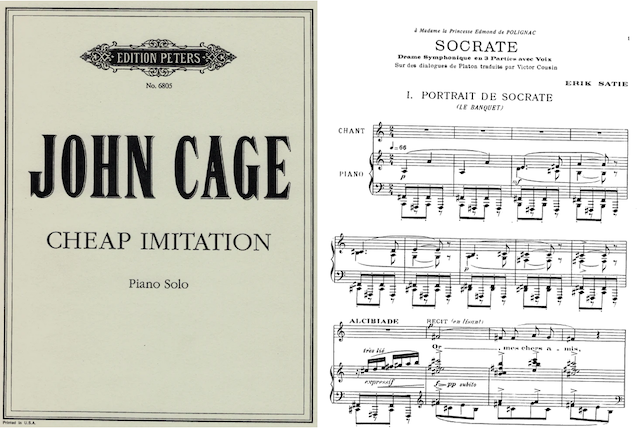
I’ve written about John Cage’s Cheap imitation for piano several times. But it was only recently that I sat down and did a careful analysis of the piece. I looked at how Cage said he composed it; I looked at the score and compared it to Satie’s Socrate; I examined the choices that Cage made…
-
How did John Cage compose Cheap imitation? We are fortunate to have his own explanation of the system right in the front of the score, and I will go through this description in detail and explain my own understanding of it.
-
I’ve spent time investigating John Cage’s Cheap imitation. In a new series of posts, I’ll document how he composed it, and also demonstrate how I go about engaging deeply with a piece like this.
-
(This text was written to accompany Mode Records CD 327 John Cage: The works for piano 11) In June of 1980, Aki Takahashi was preparing to leave Buffalo, New York. Morton Feldman, knowing her reputation as a pianist specializing in new music, had invited her to be an artist in residence at the university where…
-
Through no effort of my own, the manuscript of Cage’s 1990 version of 4′ 33″ for The Whistlebinkies wound up in my email inbox. It made the piece much more real to me and I got very interested in it again. I started having new ideas about it, and, with score in hand, more confidently…
-
I spent a recent Saturday morning chatting with Laura Kuhn of the John Cage Trust, a conversation now available online in the latest episode of her program “All Things Cage” for WGXC.
-
Silent prayer, 4′ 33″, 0′ 00″, One3: are these evolving manifestations of the same work, or are they four distinctly different works? Should we speak of John Cage’s silent piece, or John Cage’s silent pieces?
-
Unwilling to perform 4′ 33″ for a concert in Japan in 1989, John Cage created a new silent piece: One3. Dark and frightening, it confounds our expectations.
-
In 1962, to effectively present his understanding of silence to audiences, Cage wrote a new silent piece and called it 0’ 00” (4’ 33” No. 2). it is a celebration of silence in all the ways that were most meaningful to Cage and which had been missed in the concert performances of 4’ 33”.
-
While 4’ 33” is seen as a daring creation that changed music, Cage himself can be seen as its somewhat reluctant creator. Rather than embrace and promote it as the key piece in his oeuvre, Cage seems to have distanced himself from it. By turning his back on it, was he trying in some way…