Writings
Just about all of the substantive pieces of music writing that I’ve produced in the last thirty years or so are available here. Most of these are about John Cage and/or Morton Feldman. I’ve curated a list of what I think are my “essential” texts and also provide an index to the pages and blog posts for Cage and Feldman.
Essential Texts
For newcomers, here are what I consider the highlights of the essays here.
- Introduction to The music of John Cage (1993). This is the introduction from my book on Cage’s music, available from Cambridge University Press. The introduction presents my argument that Cage must be considered first and foremost as a composer, not as a philosopher.
- John Cage’s silent piece(s) (2018). An eight-part series on the history of both John Cage’s conception of silence and the four pieces that he considered to be silent: Silent prayer (1948), 4′ 33″ (1952), 0′ 00″ (1962), and One3 (1989).
- What silence taught John Cage: The story of 4′ 33″ (2009). This is an essay about Cage’s encounter with silence and how to understand the silent piece in this context. Written for the catalog of the Cage retrospective show at Museu d’Art Contemporani de Barcelona.
- On the Cage/Feldman Radio Happenings (2015). A series of blog posts about the Radio Happenings shows of 1966–1967, over four hours of conversations between John Cage and Morton Feldman broadcast on WBAI in New York. It covers the history of these shows, including the story of how I rediscovered them twenty years after their initial broadcast.
- Opening the door into emptiness (2014). This is a series of blog posts that trace the path that John Cage followed in the 1940s and early 1950s. This is journey was both spiritual and musical, and it led ultimately to the turning point in his musical career: his adoption of chance operations in 1951.
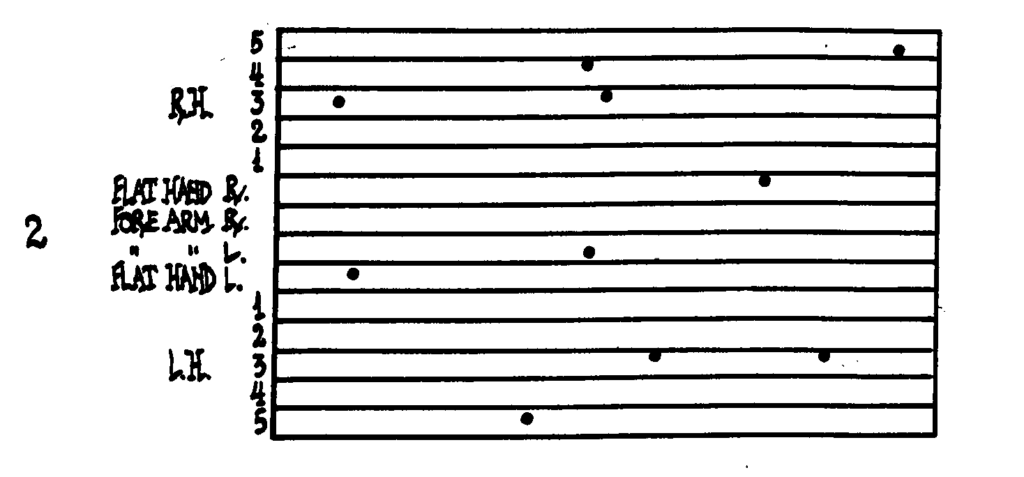
- David Tudor’s realization of Cage’s Variations II (2000). This essay documents the method Tudor used in his version of Variations II for amplified piano. It is based on my work with the Tudor manuscripts at the Getty Research Institute.
- Morton Feldman: For Bunita Marcus (2019). This is the text that accompanies the Mode Records CD of Morton Feldman’s For Bunita Marcus, performed by Aki Takahashi.
John Cage
- The origin of John Cage’s Zen (2024). An essay in which I make the argument that it was R. H. Blyth and not D. T. Suzuki who brought Zen to John Cage’s musical practice.
- Understanding Cheap Imitation (2024). A five-part series that documents the composition of the 1969 piano version of Cheap imitation.
- Cage, Satie, Feldman, Takahashi (2020). This text includes a discussion of Cheap imitation, Morton Feldman’s transcription of Cheap imitation, and other shorter piano pieces.
- John Cage’s silent piece(s) (2018). An eight-part series on the history of both John Cage’s conception of silence and the four pieces that he considered to be silent: Silent prayer (1948), 4′ 33″ (1952), 0′ 00″ (1962), and One3 (1989).
- On the Cage/Feldman Radio Happenings (2015). A series of blog posts about the Radio Happenings shows of 1966–1967, over four hours of conversations between John Cage and Morton Feldman broadcast on WBAI in New York. It covers the history of these shows, including the story of how I rediscovered them twenty years after their initial broadcast.
- Opening the door into emptiness (2014). This is a series of blog posts that trace the path that John Cage followed in the 1940s and early 1950s. This is journey was both spiritual and musical, and it led ultimately to the turning point in his musical career: his adoption of chance operations in 1951.
- A dip in the lake in Potenza (2012). An essay I wrote for an Italian performance of A dip in the lake. The story of this essay is on my blog.
- Five statements on silence by John Cage: Questions, hypotheses, second thoughts (2012). An essay for Cine Qua Non‘s John Cage issue in 2012. The story of this essay is on my blog.
- Letter to Music Report (2012). My response to questions about Cage from the Iranian music journal. The story of this essay is on my blog.
- What silence taught John Cage: The story of 4′ 33″ (2009). This is an essay about Cage’s encounter with silence and how to understand the silent piece in this context. Written for the catalog of the Cage retrospective show at Museu d’Art Contemporani de Barcelona.
- Cage and the prepared piano: a twelve-year history in six parts (2007). This is a history of Cage’s shorter solo works for prepared piano, almost all of them written for dancers.
- Imitations/transformations (2004). This text concerns Cage’s Harmonies and Cheap imitation. It accompanies the recording of these works available from Mode Records.
- One8 (2004). This is the text that accompanies the recording of the work for solo cello available on Mode Records.
- Notes on Winter music/Atlas eclipticalis and 103 (2000). This is the text that accompanies the recording of these works as conducted by Petr Kotik, available on Asphodel Records.
- David Tudor’s realization of Cage’s Variations II (2000). This essay documents the method Tudor used in his version of Variations II for amplified piano. It is based on my work with the Tudor manuscripts at the Getty Research Institute.
- Choral music: a timeline (1998). This is the text accompanies the recording from Mode Records. It presents views of a collection of Cage choral works in the context of a historical chronology.
- About continuity and Cage’s Five3 (1996). This is the text that accompanies the recording of the work for trombone and string quartet available on Mode Records
- The story of The city wears a slouch hat (1995). An account of the history of Cage’s score for Kenneth Patchen’s radio play.
- Six views of the Sonatas and Interludes (1995). As the title says, this essay presents six different perspectives on Cage’s well-known early masterpiece.
- Freeman etudes (1994). This combines the two texts that accompany the two volumes of the recording by Irvine Arditti. The first part is a general discussion of the work; the second part is an account of the completion of this work after a lengthy hiatus.
- On Europeras 3 & 4 (1994). This essay is in two parts, one for each opera. Each part consists of several sections dealing with a different aspect, view, or impression of the work.
- “Something like a hidden glimmering” (1994): John Cage and recorded sound. This is a study of John Cage’s use of recorded sound in his music. It suggests a spiritual perspective on the subject rather than a narrowly technical one.
- “Instead of separation, a sense of space” (1993). This text accompanied an installation of Cage’s Essay in Berlin.
- Introduction to The music of John Cage (1993). This is the introduction from my book on Cage’s music, available from Cambridge University Press. The introduction presents my argument that Cage must be considered first and foremost as a composer, not as a philosopher.
- The Ten Thousand Things (1988). This is the chapter from my dissertation (The use of chance techniques in the music of John Cage, 1950-1956) that deals with the “time length” pieces of 1953-1956. It is reproduced here without the figures (for which I would need scans and permissions), but otherwise intact.
- A chronological listing of all the completed musical works of John Cage
- All posts and essays on John Cage
Morton Feldman
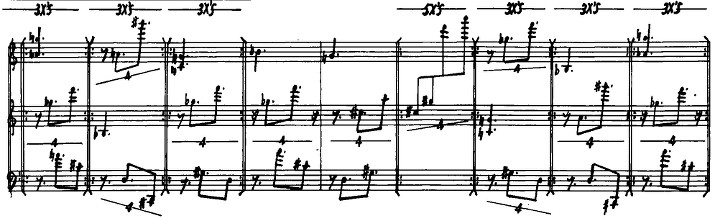
- Cage, Satie, Feldman, Takahashi (2020). Text written to accompany Mode Records CD 327 John Cage: The works for piano 11. It includes a discussion of Morton Feldman’s transcription of Cage’s Cheap Imitation.
- Morton Feldman: For Bunita Marcus (2019). This is the text that accompanies the Mode Records CD of Morton Feldman’s For Bunita Marcus, performed by Aki Takahashi.
- On the Cage/Feldman Radio Happenings (2015). A series of blog posts about the Radio Happenings shows of 1966–1967, over four hours of conversations between John Cage and Morton Feldman broadcast on WBAI in New York. It covers the history of these shows, including the story of how I rediscovered them twenty years after their initial broadcast.
- Blog posts on Morton Feldman:
Other writings
On music
- The electroacoustic dream theater of Frances White (2012). This is the text that accompanies the Pogus Productions CD of electroacoustic works by Frances White, In the library of dreams.
- Frances White: Centre Bridge (2007). This is the text that accompanies the CD of electroacoustic works by Frances White available on Mode Records. It deals with the idea of transformation in White’s work.
- Profile of Frances White (1996). This is a profile of Frances White that I wrote for Array, the journal of the International Computer Music Association.
- Richard Karpen: Processes universal and human (2015). This is the text that accompanies the Neuma recording of Richard Karpen’s Elliptic (Strandlines II) and Aperture II performed by The Six Tones and JACK Quartet.
- Walls of sound (1997). This is the text that accompanies Ulrich Krieger’s recording available on O.O. Discs. It presents a background of text about unity and constant sound, coupled with short foreground texts about the specific works on the recording.
- On Bach and the curved bow (1995). This is the text that accompanies Michael Bach’s recording of J. S. Bach’s solo cello suites. The performer uses a curved cello bow which allows him to play the three- and four-note chords without arpeggiation. My text considers the significance and historical implications of the curved bow in the performance of Bach’s music.
- Richard Strauss: Melodramas (1994). This text accompanies the recording of two Strauss melodramas (“Enoch Arden” and “The castle by the sea”) on Mode Records. The text is primarily concerned with a presentation of the medium of the melodrama in a critical perspective.
- Alternatives to explanation (1997). This is a brief text that suggests ways to avoid the trap in writing about music of explaining what happens.
Poems, etc.
- From a fairy tale (2013). Written to accompany Frances White’s composition for viol consort. This is part of a series of texts inspired by the fairy tale “The princess in the chest”.
- As night falls (2011). Written to accompany Frances White’s composition for violin, viola, narrator, and electronic sound. This is a “sequel” to The old rose reader.
- The Old Rose Reader (2002). Written to accompany Frances White’s composition for violin and electronic sound. For the composition, an animated text video was made.
- While listening to the waves (at Island Beach) (1998). Written to accompany Frances White’s composition for erhu, zheng, xiao, and pipa.
- Birdwing (for Frances) (1996). Written to accompany Frances White’s composition for shakuhachi and tape.