After I learned the first seven pages of For Bunita Marcus, I allowed myself to continue to the next chunk of music. Pages 8-10 are almost completely taken up with the same image made up of two oscillations: an E-flat and G-flat in the right hand, and a C and D in the left:
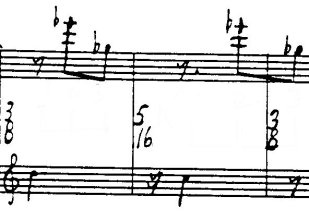
Feldman plays with this pattern for the next four minutes of the score; I’ll go ahead and do the play-by-play here. He opens with the eighth-note pattern above, and over the next ten bars or so he moves the patterns around rhythmically so that the left hand notes move out of phase with the right hand, and the overall length of the pattern expands and contracts subtly. Following this, the left-hand/right-hand pattern changes: the two notes in the right hand settle into a slower, straight quarter-note rhythm, while the notes in the left hand continue as before. This causes a fundamental change in the image, from a three-note phrase to a series of two note phrases:
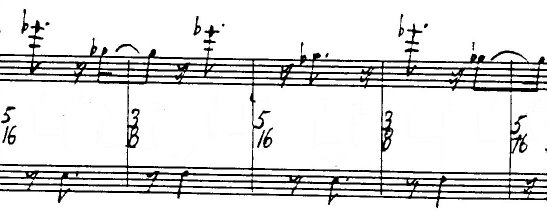
The quarter-note pulse disappears, but the two-note phrases continue, spreading out and becoming more sparse. At the top of page 9, the three-note arrangement returns, but with a change in direction in the right hand:
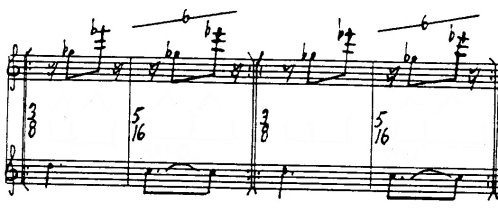
The sextuplet over 5/16 boggles the mind, but I approach this as a written-out tempo change and just play the 5/16 bars “a little too fast.” Page 9 then rings more changes on the patterns of page 8, again slowing down and spreading out by the end of the page. The top of page 10 announces a different formulation of the same basic sonority, changing the C to a C-sharp and combining the notes in the right hand:
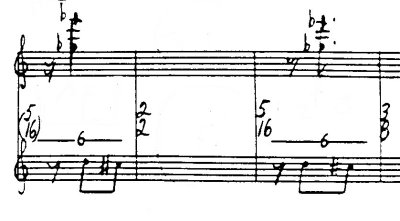
The shifting rhythmic patterns return after this, but with the notes in the right hand moving chromatically within the range of C to E-flat before settling on C-sharp and D. Finally, at the end of page 10, Feldman puts this image aside.
First, let me say that this section is a nightmare to count. With the exception of the top of page 10, all of this music uses alternating bars of 3/8 and 5/16, but the patterns themselves have no alignment with the barlines. This, plus the irregularity of Feldman’s manuscript, make the score almost impossible to read. I’ve made up counts of two to four eighth notes and marked them in the score throughout so that I can count and keep track of where I am, and where the notes come relative to an eighth-note pulse. Here’s a before-and-after of the score to give you an idea of how I’m doing it:
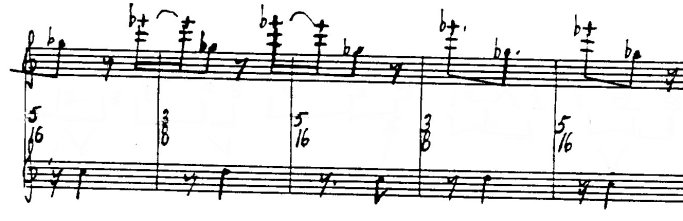
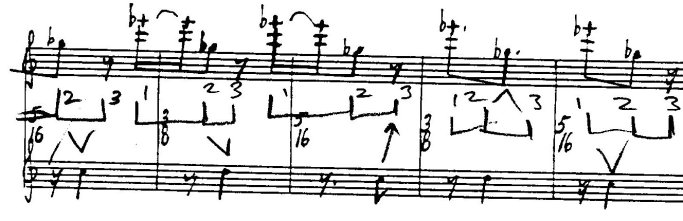
Preparing the score in this manner feels a little bit like doing math homework, but it’s helped me bring this section under control. The main difficulty now is keeping it even and calm, even while I count furiously under my breath. It should float for four minutes and not sound mechanical.
In an earlier posting, I made the case that what Feldman does with his images isn’t just repetition and that it doesn’t really belong stylistically with classic minimalism. But the lack of pauses here, the basic eighth-note pulse, and the shifting, almost hocketing patterns of pages 8-10 make me see how you could make that argument. But there’s nothing motoric about the patterns here: they have too many gaps and irregularities in them, they clump together and thin out. And ultimately we don’t really get anywhere, although the meandering chromatic line in the left hand at the end suggests some kind of discovery. It feels a bit like a cop-out to say that this is just four minutes of a particular color wash, but perhaps that is indeed what’s going on here. I keep having to remind myself that we’re only about a third of the way through and there’s no telling what will come next.

Leave a Reply