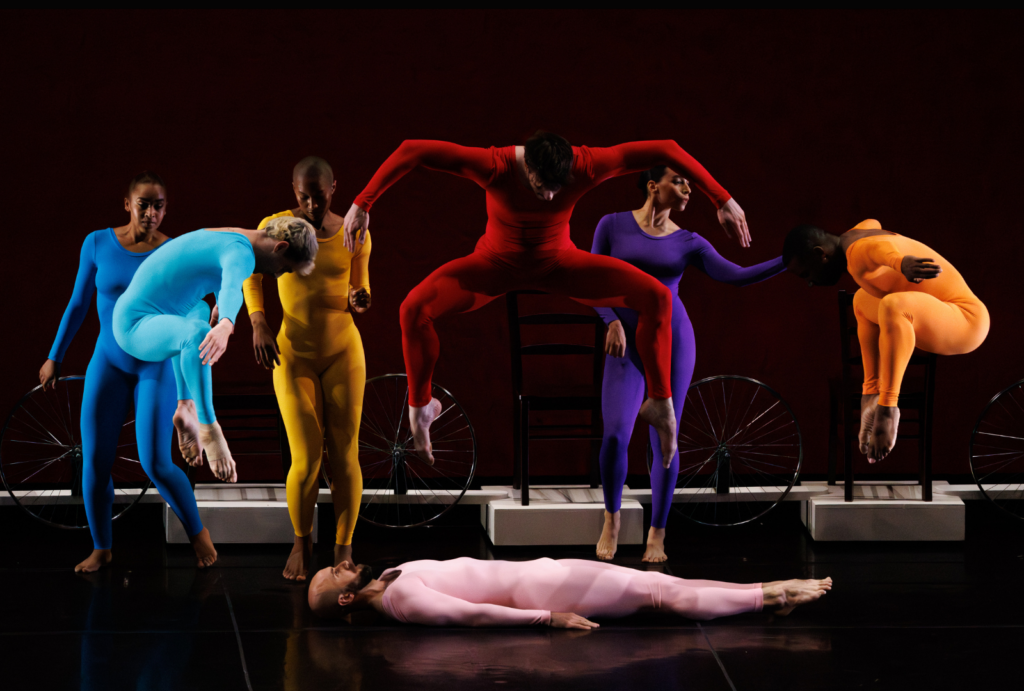
I recently saw the Tricia Brown Dance Company in a performance at the Brooklyn Academy of Music (BAM). It was billed as a tribute to Robert Rauschenberg and featured two dances for which he had done the set and costume design: Brown’s Set & Reset (1983) and Merce Cunningham’s Travelogue (1977). I was particularly interested to see Travelogue, which includes music by John Cage: Telephones and Birds for three performers.
I knew the basic outlines of Telephones and Birds: the performers play recordings of bird songs and also make telephone calls to various lines with prerecorded announcements. When I think of the latter, I think of things like the numbers we used to call to get the current time or weather. I also remember the various “dial-a-” services like Dial-A-Prayer or Dial-A-Poem.
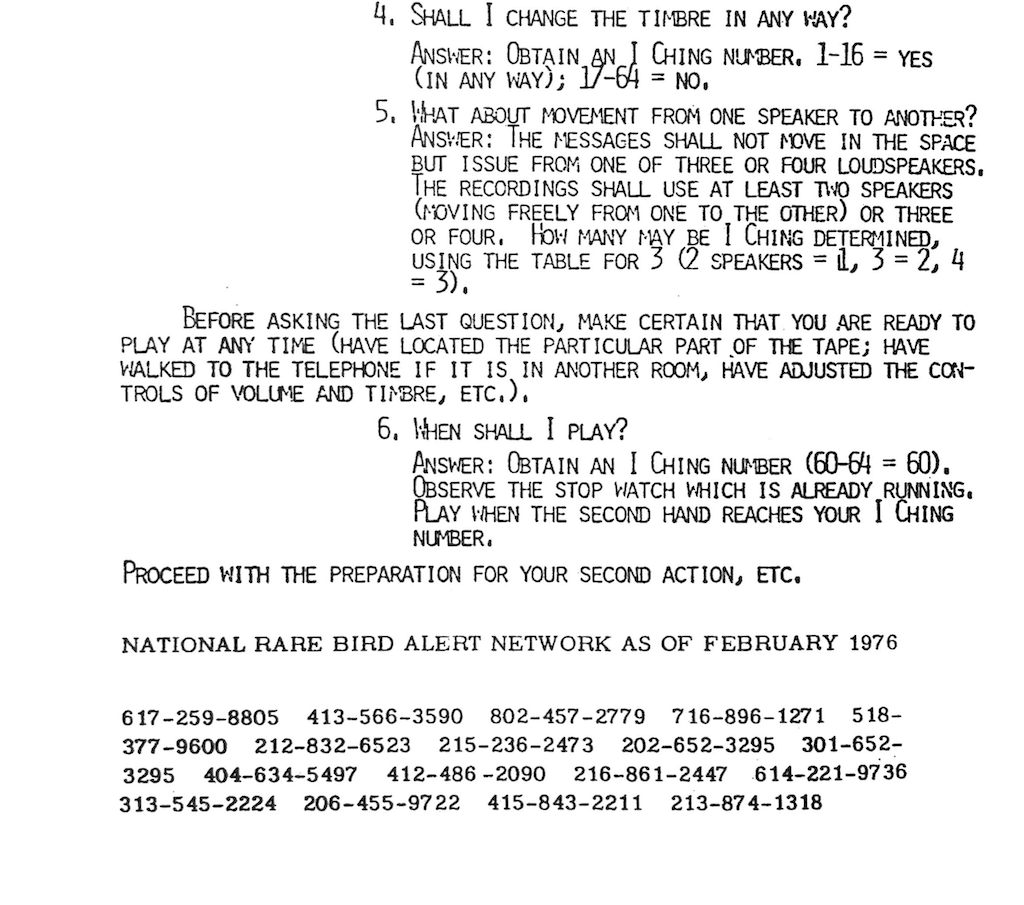
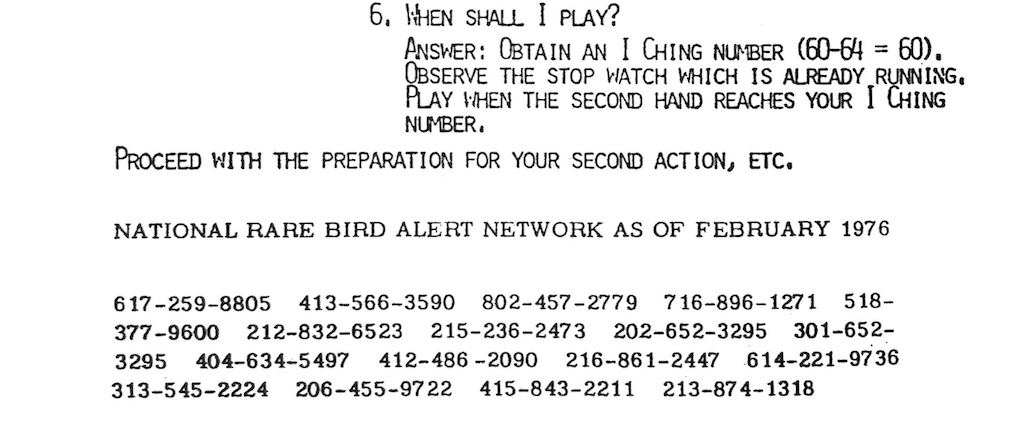
Telephones and Birds brings together technology and nature, two of John Cage’s deepest sources of inspiration. The piece probably owes its specific combination of phones & birds to a particular family of recorded announcement phone lines: the Rare Bird Alert Network of the National Audubon Society. These were several numbers around the country that a birdwatcher could call to hear a listing of the interesting sightings in their local area. Cage corresponded with the Audubon Society when preparing this piece, and listed seventeen of their numbers in the score to Telephones and Birds. I don’t know who introduced Cage to the Rare Bird Alerts, but I could easily imagine it being one of his mushroom-hunting friends.
As I recalled those old prerecorded telephone numbers, I realized that performers today would need to adapt a bit: those services really wouldn’t have survived the Internet. For example, the bird alert lines were gradually replaced by web sites and then phone apps; as of 2021, only one such number was still active (a line in Ohio maintained for technology-avoiding Amish birders). And, of course, telephones aren’t what they used to be, either. How would the piece work in 2026? Looking at the BAM dance program, I was pleased to see that Adam Tendler was directing the performances. Adam is such a thoughtful and respectful musician; I knew that he would handle this somewhat antique score with care.
I couldn’t really see the performers in the pit very well from my balcony seat, but I could see that they had papers for taking notes and their cell phones ready. When they started making calls, I immediately recognized the adaptations needed. Many were calls to customer service lines and other menu-driven phone systems. It was a bit of a disappointment, the mundane (and often annoying) “please select from the following options” routine just didn’t quite mesh with the joyousness of the dance, not in the way that, say, Dial-A-Joke would have back in 1977. The audience laughed at some of the choices (the very “meta” appearance of the customer service line for BAM, for example). The bird songs, of course, are eternal and weathered the nearly half-century since the piece’s premiere with grace. The performance was successful, but clearly not the same music that would have been experienced in 1977.
After the show, I kept thinking about the piece and the performance problems it raised. To dig deeper, I contacted Adam to get copies of the score and of his realization. The score says that the piece is “for three to perform.” This suggests a piece (like 0′ 00″) that is concerned more with the actions that performers make than with the specific sounds. And indeed, the description of sounds in the score are simple and general, while the performers’ actions take up a lot more of the instructions.
The score consists of text describing what the performers are to do. The rules (simplified here):
- Identify some number of “recorded telephone announcements (messages not requiring response on the part of the one calling).”
- Acquire some number of recorded bird calls. In the 1977 performances, these were on tape (New York Public Library has the original open reel masters).
- Relate these numbers to the 1–64 range of the I Ching, so that numbers 1–32 map to a phone call and 33–64 map to a bird call.
- Consult the I Ching (either by tossing coins or from a pre-generated list) to determine:
- Which phone or bird call is next
- Duration: how long to play this call (up to the entire length of the recording)
- Loudness: either a fixed level or “any looplike variation in loudness”
- Timbre: whether or not to alter the timbre (in any way)
- Spatial movement: whether or not to move the sound between loudspeakers
- When to begin playing, in reference to a running stopwatch
- Follow the above determinations to make the next sound
- Repeat steps 4 and 5 above until the end of the agreed-upon performance duration.
It’s very clear that the consultation of the I Ching is part of the performance itself and not something done ahead of time. The score indicates that the incidental sounds of this work—tossing coins, taking notes, preparing the playback device—can be amplified (again, just like 0′ 00″). So the sounds of Telephones and Birds consist of a series of phone and bird calls, separated by somewhat lengthy (and possibly amplified) silences while each performer figures out what to do next.
Adam also sent me the instructions he gave to the performers at the BAM performances. He refers to this as a “worksheet/transcription for smartphone.” For Adam, Telephones and Birds poses problems in performance practice: “I completely understand the almost staggering difference between a 1977 realization of this piece and what happens with a cell phone.”
Adam took the original score and reimagined it to operate as simply as possible using just a phone. Rather than try to raid the technology museums for authentic 1970s-era telephones, he wanted to find a way to make the piece work with today’s technology. “For me it was more like: this is where we are, and here’s how to make this piece both portable but also accessible to any ‘three to perform,’ as [Cage] puts it.”
For his transcription, he replaced the consulting of the I Ching with a simple random number generator, accessed on the phone. The performers use the phone to call numbers that “will result in a recording, not a human being answering.” Adam urges the performers to choose numbers that don’t require interaction, but, as I heard in the performance, performers don’t always find that easy to accomplish (“One has to really work to find these numbers,” says Adam). The bird calls are also played from the phone, either from “a music streaming service . . . , creating a playlist, using a pre-made album, etc.” He also provides a link to a website that serves up 30 random calls from around the world. The process then proceeds as in the original: generate random numbers to determine which call is next and how and when to play it, then perform this action.
Mostly, Adam’s choices in the transcription come from a desire to keep the process simple and efficient. “The process [Cage] describes sounds incredibly complex, start to finish,” Adam told me, and, in part, he saw modern phones as a way to cut down on the complexity. “Maybe there is also a bit to be gained in the almost steady ebb and flow of birds, phone dialing/messages, silence, scribbling . . . perhaps without the buffer of wrestling with intermediary technology.” In keeping with this overall direction of simplifying the mechanics of the piece, he discouraged performers from using laptops or outboard sound processing gear, and he sidestepped the instructions on spatial distribution of sound altogether. “I really wanted even this . . . ultra-streamlined version to have a sense of simplicity and even the slightest nod to its analog roots.”
One way to view Telephones and Birds as a problem in performance practice is to focus on the sounds of the piece. From this perspective, the problem is mostly with the telephone side of it. Calling answering machines with rotary telephones just isn’t an option today. But it’s not mainly a hardware problem. If you could get three landline connections into the performance space (possible but probably expensive and impractical), you’d just need to get some working rotary phones and some outboard gear to make them work on modern lines to have the full 1970s telephony sound.
The real blocker is a software or service problem: nobody uses answering machine technology any more, so even if you got the rotary phones, there’s nobody to call. In 1977, the nature of the calls would have been: dial the number, it rings, it picks up and someone talks to you: they tell you a story, present some information, tell a joke, recite a poem. The calls today are transactional, not informational: menus of options or prompts to leave a message. What used to be like a gift or a message in a bottle is now just another request for your personal information.
So the telephonic sound content of Telephones and Birds is not recoverable, but to me there’s a much deeper loss here. Our attitudes towards telephone technology and our perception of it is so vastly different now than it was in 1977. The sight (and sounds) of someone dialing a telephone from the orchestra pit of a theater would have piqued the audience’s interest in the 1970s. Some might have seen it as transgressive in some way. In 2026, I was struck by how invisible phones have become to us: they’re just so ubiquitous that we don’t notice them. We think of them as common, everyday tools like pens and pencils. Seeing performers using them in Telephones and Birds was not very far at all from musicians playing from tablets in chamber ensembles or orchestras.
Adam’s transcription for modern smartphones leans into the effortlessness and transparency of today’s technology. He sees this as a plus because he wondered “if all of that other activity might (have once) overshadow(ed) the actual content/material of the piece: the telephones and birds.” In 2026, the telephones no longer strike us as stage props, ominously waiting to trigger action by ringing or by being picked up and dialed. Instead they are portals: the faucets that open up endless streams of hot and cold running content.
When we expand the meaning of the piece beyond sound to the whole theater of the experience—composer, performers, and audience included—a historically authentic performance seems impossible. We’ll never think of telephones and prerecorded messages the same way. As John Cage conceived of it, Telephones and birds is hopelessly stuck in an analog past. Consider just one of the details about the score: the emphasis that it places on getting permission to use the prerecorded calls in a performance situation. Private ownership of audio content is so devalued now that this propriety seems quaintly old-fashioned.
As I reflected on this, I realized that here in the twenty-first century we find ourselves in a unique position as far as performance practice is concerned. As with all questions of original versus modern instruments, we’re dealing with technological change. But technology moves so rapidly today that the changes within a single lifetime are akin to the more gradual changes in musical instruments we typically think of when grappling with performances on modern instruments. The ancient instruments of the past—rotary landline telephones calling answering machines—were used within our (or at least my) living memory. This means that we don’t have to guess about the earlier performance practice: some of us lived it, even though it can’t really be recreated today. I have to admit a certain nostalgia for that lost analog world when I read the score to Telephones and birds and even when I experienced its smartphone adaptation.
But really, is authenticity all that relevant here? What does “authenticity” mean in the context of experimental music, where the outcome is unknown? Cage’s composing was always motivated by a spirit of “what would happen if I tried this?” Telephone technology is just one environmental variable for the experiment that is Telephones and Birds. Performing and experiencing it is all an ongoing process, even as the media and technology culture change so dramatically. Attending the performance at BAM just made me realize how much a part of the process I myself am, sitting in the balcony and watching three guys fiddle with their phones.

Leave a Reply