I’ve started working on Morton Feldman’s Palais de mari. Written in 1986, it was his last solo piano work. I figured that this was a good way to start on late Feldman. It’s a “shorter” work: only 20-30 minutes long! I’ll be doing a number of posts on this piece as it sinks in. Some of the ideas will be half-baked, I’m sure, but I want to write as the music soaks into my fingers and brain.
And I’ll start at the beginning:
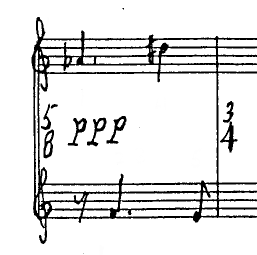 These late pieces of Feldman’s all seem to open with a particular kind of idea: a striking motive that commands your attention, that has a clearly identifiable and memorable shape, and that hangs in the air, suggesting more to come. The four-note opening of Palais de mari — like the openings of For Philip Guston, For Bunita Marcus, Piano and string quartet, etc. — is an opening door. We stand at the threshold and peer in, then start to pass through the doorway and start the journey, even though we have no idea where we’re going to wind up. I’m still working on getting just the right touch for this motive, but to me it sounds like an extended two-note phrase (a-flat to d-sharp), with the accompaniment out of synch. Palais de mari is chock full of two-note (or two-chord) phrases, so this seems right to me.
And, like the other late Feldman pieces, he immediately repeats this motive, but with slight rhythmic adjustments. In this case, the notes move around, an eighth-note or quarter-note earlier or later:
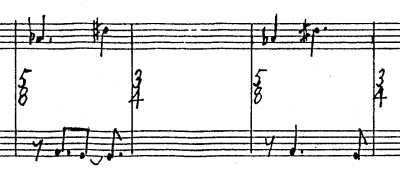
This repetition in late Feldman is sometimes associated with “Minimalism”, but I don’t see this at all. Presumably the connection is being made to the repeating patterns in music by composers such as Steve Reich, Phillip Glass, or Terry Riley, but they really have nothing to do with each other. In Feldman, the repetition never sounds like a thing being duplicated, either to fill duration or to demonstrate a process being worked out. It has the nature of an image or thought being sustained, reflected upon. The thing is never repeated exactly, but is blurred a bit by minor changes of rhythm, register, or voicing. It’s not really “development”, either, at least not in the usual Germanic way. The motive is always exactly what it is sonically, never abstracted or changed to point to some underlying unity. Instead of repeating or developing, I’d say that the idea persists: it hovers somewhere in our imagination, its boundaries not quite distinct and becoming vaguer with each appearance.
I said that one of the characteristics of the opening ideas of late Feldman works is that they are memorable. In fairly short order the music moves away from them as new ideas appear. These new ideas persist, as we move further and further away from where we started. Inevitably the opening motive appears later on in the piece: in the case of Palais de mari, the opening idea shows up twice again in the first half of the piece and then disappears forever. Whenever these opening motives reappear, we recognize them as a return: they instill in us the feeling of starting over. This is because these ideas will always be associated in our minds with the open door and the dimly-lit entrance way that got us started, before we lost our way in the passageways of Feldman’s musical world.

Leave a Reply