Tag: cage
-
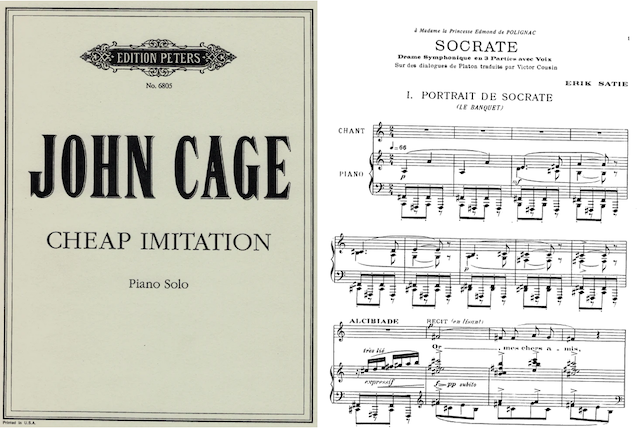
I’ve spent time investigating John Cage’s Cheap imitation. In a new series of posts, I’ll document how he composed it, and also demonstrate how I go about engaging deeply with a piece like this.
-
(This text was written to accompany Mode Records CD 327 John Cage: The works for piano 11) In June of 1980, Aki Takahashi was preparing to leave Buffalo, New York. Morton Feldman, knowing her reputation as a pianist specializing in new music, had invited her to be an artist in residence at the university where…
-
Through no effort of my own, the manuscript of Cage’s 1990 version of 4′ 33″ for The Whistlebinkies wound up in my email inbox. It made the piece much more real to me and I got very interested in it again. I started having new ideas about it, and, with score in hand, more confidently…
-
Morton’s Feldman’s graph music—a music that was silent about which pitches should be played—changed Cage’s work forever. Cage expressed his understanding of Feldman’s radical act in a new lecture, the “Lecture on something”.
-
Morton Feldman’s “Projection” showed John Cage the destination of his musical-spiritual journey. It was a revelation, the opening of a door to an entirely new world, “not just the musical world outside of you”, as he later described it, “but the musical world inside of you.”
-
By 1950 Cage had arrived at a style that celebrated emptiness. Paradoxically, by letting go any strong self-expression, he discovered a truer musical voice. His next major work, the Concerto for prepared piano and chamber orchestra, was to explicitly present this release from self-expression.
-
Energized by the discoveries of the quartet, Cage created his first really great piece of writing in 1950, the “Lecture on nothing”. It eloquently presents Cage’s belief that self-negating discipline produces insight.
-
Through the composition of his “String quartet in four parts”, Cage went further on the path of “self-knowledge through self-denial”. In it, he discovered a non-expressive use of harmony, and he did it by treating materials in a systematic fashion.
-
In his writings “Defense of Satie” and “Forerunners of modern music”, Cage attempted to build a framework for music that could integrate what he needed in his life from both traditional and avant-garde music. In the process his work and thought began moving in the direction of “self-knowledge through self-denial”.
-
This series of posts traces the musical-spiritual path that John Cage followed in the 1940s and early 1950s.